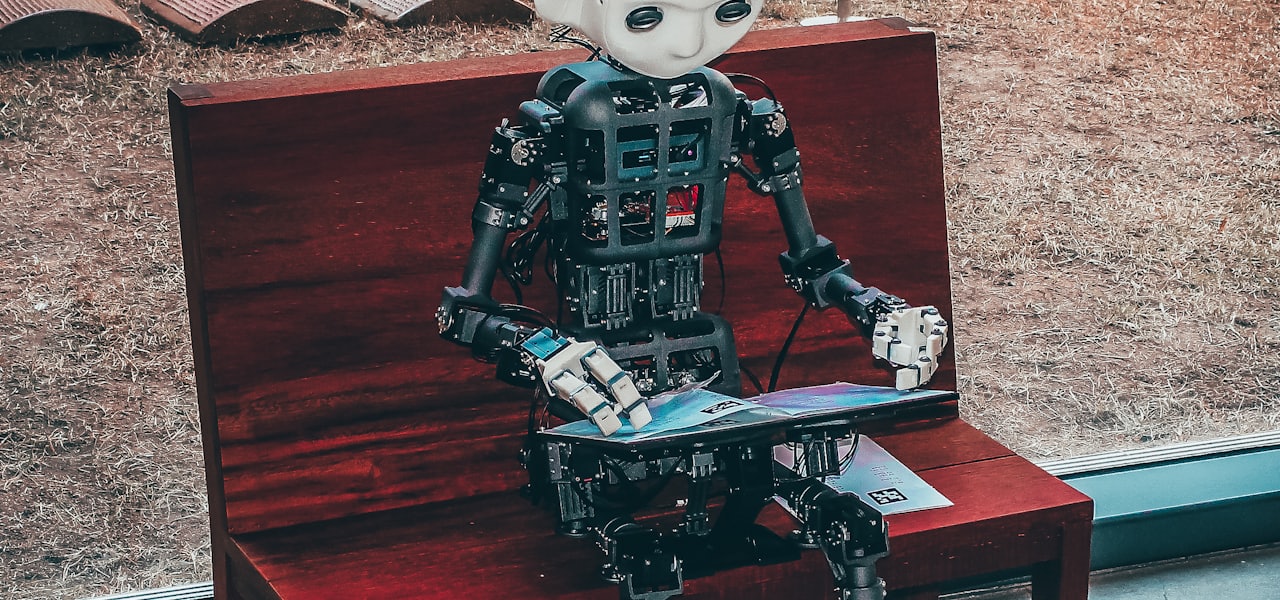
Bin picking (also referred to as random bin picking) is a core problem in computer vision and robotics. The goal is to have a robot with sensors and cameras attached to it pick-up known objects with random poses out of a bin using a suction gripper, parallel gripper, or other kind of robot end effector. Early work on bin picking made use of Photometric Stereo in recovering the shapes of objects and to determine their orientation in space. Amazon previously held a competition focused on bin picking referred to as the "Amazon Picking Challenge", which was held from 2015 to 2017. The challenge tasked entrants with building their own robot hardware and software that could attempt simplified versions of the general task of picking and stowing items on shelves. The robots were scored by how many items were picked and stowed in a fixed amount of time. The first Amazon Robotics challenge was won by a team from TU Berlin in 2015, followed by a team from TU Delft and the Dutch company "Fizyr" in 2016. The last Amazon Robotics Challenge was won by the Australian Centre for Robotic Vision at Queensland University of Technology with their robot named Cartman. The Amazon Robotics/Picking Challenge was discontinued following the 2017 competition. Although there can be some overlap, bin picking is distinct from "each picking" and the bin packing problem.
Adobe InDesign
Adobe InDesign is a desktop publishing and page layout designing software application produced by Adobe and first released in 1999. It can be used to create works such as posters, flyers, brochures, magazines, newspapers, presentations, books and ebooks. InDesign can also publish content suitable for tablet devices in conjunction with Adobe Digital Publishing Suite. Graphic designers and production artists are the principal users. InDesign is the successor to PageMaker, which Adobe acquired by buying Aldus Corporation in late 1994. (Freehand, Aldus's competitor to Adobe Illustrator, was licensed from Altsys, the maker of Fontographer.) By 1998, PageMaker had lost much of the professional market to the comparatively feature-rich QuarkXPress version 3.3, released in 1992, and version 4.0, released in 1996. In 1999, Quark announced its offer to buy Adobe and to divest the combined company of PageMaker to avoid problems under United States antitrust law. Adobe declined Quark's offer and continued to develop a new desktop publishing application. Aldus had begun developing a successor to PageMaker, code-named "Shuksan". Later, Adobe code-named the project "K2", and Adobe released InDesign 1.0 in 1999. InDesign exports documents in Adobe's Portable Document Format (PDF) and supports multiple languages. It was the first DTP application to support Unicode character sets, advanced typography with OpenType fonts, advanced transparency features, layout styles, optical margin alignment, and cross-platform scripting with JavaScript. Later versions of the software introduced new file formats. To support the new features, especially typography, introduced with InDesign CS, the program and its document format are not backward-compatible. Instead, InDesign CS2 introduced the INX (.inx) format, an XML-based document representation, to allow backward compatibility with future versions. InDesign CS versions updated with the 3.1 April 2005 update can read InDesign CS2-saved files exported to the .inx format. The InDesign Interchange format does not support versions earlier than InDesign CS. With InDesign CS4, Adobe replaced INX with InDesign Markup Language (IDML), another XML-based document representation. InDesign was the first native Mac OS X publishing software. With the third major version, InDesign CS, Adobe increased InDesign's distribution by bundling it with Adobe Photoshop, Adobe Illustrator, and Adobe Acrobat in Adobe Creative Suite. Adobe developed InDesign CS3 (and Creative Suite 3) as universal binary software compatible with native Intel and PowerPC Macs in 2007, two years after the announced 2005 schedule, inconveniencing early adopters of Intel-based Macs. Adobe CEO Bruce Chizen said, "Adobe will be first with a complete line of universal applications." == File format == The MIME type is not official File Open formats: indd, indl, indt, indb, inx, idml, pmd, xqx New File formats: indd, indl, indb File Save As formats: indd, indt Save file format for InCopy: icma (Assignment file) icml (Content file, Exported file) icap (Package for InCopy) idap (Package for InDesign) File Export formats: pdf, idml, icml, eps, jpg, txt, XML, rtf == Versions == Newer versions can, as a rule, open files created by older versions, but the reverse is not true. Current versions can export the InDesign file as an IDML file (InDesign Markup Language), which can be opened by InDesign versions from CS4 upwards; older versions from CS4 down can export to an INX file (InDesign Interchange format). === Server version === In October 2005, Adobe released InDesign Server CS2, a modified version of InDesign (without a user interface) for Windows and Macintosh server platforms. It does not provide any editing client; rather, it is for use by developers in creating client-server solutions with the InDesign plug-in technology. In March 2007 Adobe officially announced Adobe InDesign CS3 Server as part of the Adobe InDesign family. == Features == Paragraph styles are an essential tool for designers when working with text in Adobe InDesign. Despite their menacing appearance, they are straightforward to operate. Other features that make InDesign a good tool for working with text and paragraphs include: Creating frames and shapes Aligning objects with grids and guides Manipulating objects Organizing objects Importing text Formatting text Spell checking Importing images Parent pages (formerly master pages) Paragraph styles == Internationalization and localization == InDesign Middle Eastern editions have unique settings for laying out Arabic or Hebrew text. They feature: Text settings: Special settings for laying out Arabic or Hebrew text, such as: Ability to use Arabic, Persian or Hindi digits; Use kashidas for letter spacing and full justification; Ligature option; Adjust the position of diacritics, such as vowels of the Arabic script; Justify text in three possible ways: Standard, Arabic, Naskh; Option to insert special characters, including Geresh, Gershayim, Maqaf for Hebrew and Kashida for Arabic texts; Apply standard, Arabic, or Hebrew styles for page, paragraph, and footnote numbering. Bi-directional text flow: Right-to-left behavior applies to several objects: Story, paragraph, character, and table. It allows mixing right-to-left and left-to-right words, paragraphs, and stories in a document. Changing the direction of neutral characters (e.g., / or ?) is possible according to the user's keyboard language. Table of contents: Provides a table of contents titles, one for each supported language. This table is sorted according to the chosen language. InDesign CS4 Middle Eastern versions allow users to select the language of the index title and cross-references. Indices: This allows the creation of a simple keyword index or a somewhat more detailed index of the information in the text using embedded indexing codes. Unlike more sophisticated programs, InDesign cannot insert character style information as part of an index entry (e.g., when indexing book, journal, or movie titles). Indices are limited to four levels (the top level and three sub-levels). Like tables of contents, indices can be sorted according to the selected language. Importing and exporting: Can import QuarkXPress files up to version 4.1 (1999), even using Arabic XT, Arabic Phonyx, or Hebrew XPressWay fonts, retaining the layout and content. Includes 50 import/export filters, including a Microsoft Word 97-98-2000 import filter and a plain text import filter. Exports IDML files can be read by QuarkXPress 2017. Reverse layout: Include a reverse layout feature to reverse the layout of a document when converting a left-to-right document to a right-to-left one or vice versa. Complex script rendering: InDesign supports Unicode character encoding, and Middle Eastern editions support complex text layouts for Arabic and Hebrew complex scripts. The underlying Arabic and Hebrew support is present in the Western editions of InDesign CS4, CS5, CS5.5, and CS6, but the user interface is not exposed, making it difficult to access.
Galatea (video game)
Galatea is an interactive fiction video game by Emily Short featuring a modern rendition of the Greek myth of Galatea, the sculpture of a woman that gained life. It took "Best of Show" in the 2000 IF Art Show and won a XYZZY Award for Best non-player character. The game displays an unusually rich approach to non-player character dialogue and diverts from the typical puzzle-solving in interactive fiction: gameplay consists entirely of interacting with a single character in a single room. Galatea is licensed under the Creative Commons BY-NC-ND 3.0 US license. == Gameplay == Galatea alters the typical interactive fiction game mechanics by concentrating instead on the player's interactions with a single non-player character (NPC), the eponymous Galatea. Much of the interest of the piece derives from the ambiguous nature of the player–NPC dialogue: the form of the conversation and, indeed, the nature of Galatea herself shift depending on the focus the player places on certain aspects of the character's personality. Numerous endings are possible. Gameplay centers around the developing dialogue between Galatea and the player when asking about topics in the previous conversation. Two commands, "think about" and "recap", are provided to keep track of what has already been said; the former is also used to advance the storyline, as the player character draws conclusions about the story as it has unfolded to that point. The game also encourages using sensory commands ("touch", "listen to", "look at"), adding immersion to the experience. == Plot == Galatea is loosely based on the myth of Pygmalion, who carved the sculpture of a woman. In the myth, he falls in love with the statue, named Galatea or Elise in different versions, and the goddess Venus brings her to life. The story begins at the opening of an exhibition of artificial intelligences. The player, alone, discovers Galatea displayed on a pedestal with a small information placard. She is illuminated by a spotlight and wears an emerald dress. Seeing the player about to turn away, Galatea says, "They told me you were coming." From this point, the story may proceed in a number of ways depending on the player's words and actions. === Multilinear interactive fiction === Short describes this as "multilinear interactive fiction": while interactive fiction in general allows the player to find their own way through the story, this leads in most cases to a single ending (or at least a single desired 'correct' ending). With Galatea, Short presents a story with around 70 different endings and hundreds of possible ways of reaching them. The plot is thus designed to appear open-ended with the development of the story entirely dependent on what the player decides to talk or ask about or what actions they choose to perform. Thus the original author and the player share in the creation of a work of fiction. == Development == In interviews, Emily Short has explained that Galatea arose out of her efforts to develop advanced dialog coding for interactive fiction engines. Although code for simple conversational programs like ELIZA have existed since the 1960s, and limited dialog options have existed in interactive fiction since the 1970s, Short's efforts to develop chatterbot-like dialog required her to produce a simple test case scenario to test NPC interaction. Thus the single-room, single-occupant Galatea was a natural result. Development of the game progressed organically with Short engaging in test runs and drafting new dialog options for every conversational dead-end that arose. The game's multiple endings also arose in a similar fashion although Short had intended that there be multiple endings from the start. Although the nature of the game's development as well as its minimalist final form has led to questions regarding whether it is really a game and not just an experimental conversational program, Short has suggested that to her the definition of interactive fiction requires nothing more than a world model and a parser, and "anything you can cook up with those features counts as IF." Short has acknowledged the helpful influence of the close-knit IF community and the "atmosphere in which experimentation is valued" as leading to the success of her works like Galatea. == Reception == Galatea was well received, achieving critical acclaim from interactive fiction reviewers and literary scholars. The game is considered to aspire to a new level of art in interactive fiction, and thereby to have revolutionized the genre, establishing its author, Emily Short, as one of the key figures in the modern interactive fiction scene. Fellow award-winning IF author, Adam Cadre has called Galatea "the best NPC ever"—a view that was echoed by Joystiq's John Bardinelli. Cadre also describes the game as an example of an alternative kind of puzzle where "interactivity comes in deciding where to go, what to see, what to say. Rather than having to open gates along a path, you discover that they're all open at first, but stepping through one causes others to close." Galatea was described in 2007 by Indiegames.com as a "fascinating journey." In a 2009 article, Rock, Paper, Shotgun praised the depth and detail of the game, the complexities of the character design and its "masterful balance between intricacy and simplicity", and "Galatea's emotional turmoil" that is "encoded sweetly into the subtext of what's going on. By simply interacting in a logical manner, you learn more about this character than any cut-scene or info-dump could ever hope to convey." This was reiterated in a 2010 1UP.com article that listed Galatea as #2 in its "Top 5 Introductory Interactive Fiction Games" feature, describing it as intriguingly replayable, and as a "surprisingly rich game for its apparent minimalism". In 2011, PC Gamer highlighted Galatea as an example of the artistic and literary aspects of the interactive fiction genre. The titular character, Galatea, has been compared to the 2007 Portal character GLaDOS due to similarities in the personalities of the characters.
Generative engine optimization
Generative engine optimization (GEO) is one of the names given to the practice of structuring digital content and managing online presence to improve visibility in responses generated by generative artificial intelligence (AI) systems. The practice influences the way large language models (LLMs) retrieve, summarize, and present information in response to user queries. Related terms include answer engine optimization (AEO) and artificial intelligence optimization (AIO). The concept of GEO first appeared in response to generative AI technologies being integrated into mainstream search and information retrieval systems. Tools are used to monitor how websites and brands are cited, referenced, or incorporated into responses produced by large language models. == Terminology == Several overlapping terms describe related practices, and usage varies across practitioners, vendors, and publications. No consensus definition distinguishing these terms had been established in the academic literature as of early 2026, and the terms are frequently used interchangeably in trade and practitioner contexts. Other terms for the same concept include answer engine optimization (AEO), large language model optimization (LLMO), artificial intelligence optimization (AIO), and AI SEO. In 2026, Google released documentation entitled "Optimizing your website for generative AI features on Google Search." According to this documentation, "optimizing for generative AI search is optimizing for the search experience, and thus still SEO.” This position had previously been shared at conferences, with 2026 being the first time Google released official documentation stating it. == Factors influencing generative engine optimization == By early 2026, the focus of GEO practitioners shifted from simple keyword placement to "semantic relevance", a metric driven by the integration of advertising into conversational AI. OpenAI and Google began monetizing AI search results, which is not currently considered an aspect of generative engine optimization but is adjacent.
Supreme Commander (video game)
Supreme Commander (sometimes SupCom) is a 2007 real-time strategy video game designed by Chris Taylor and developed by his company, Gas Powered Games. The game is considered to be a spiritual successor, not a direct sequel, to Taylor's 1997 game Total Annihilation. First announced in the August 2005 edition of PC Gamer magazine, the game was released in Europe on February 16, 2007, and in North America on February 20. The standalone expansion Supreme Commander: Forged Alliance was released on November 6 of the same year. The sequel, Supreme Commander 2, was released in 2010. Nowadays, the original Supreme Commander is played through the community client called Forged Alliance Forever; the game has been further developed and balanced, and offers a wide variety of community mods. The gameplay of Supreme Commander focuses on using a giant bipedal mech called an Armored Command Unit (ACU), the so-called "Supreme Commander", to build a base, upgrading units to reach higher technology tiers, and conquering opponents. The player can command one of three factions: the Aeon Illuminate, the Cybran Nation, or the United Earth Federation (UEF). The expansion game added the Seraphim faction. Supreme Commander was highly anticipated in pre-release previews, and was well received by critics, with a Metacritic average of 86 out of 100. == Gameplay == Supreme Commander, like its spiritual predecessors, Total Annihilation and Spring, begins with the player solely possessing a single, irreplaceable construction unit called the "Armored Command Unit," or ACU, the titular Supreme Commander. Normally the loss of this unit results in the loss of the game (Skirmish missions can be set for a variety of victory conditions). These mech suits are designed to be transported through quantum gateways across the galaxy and contain all the materials and blueprints necessary to create an army from a planet's native resources in hours. All standard units except Commanders and summoned Support Commanders (sACU) are self-sufficient robots. All units and structures belong to one of four technology tiers, or "Tech" levels, each tier being stronger and/or more efficient than the previous. Certain lower-tier structures can be upgraded into higher ones without having to rebuild them. The first tier is available at the start of the game and consists of small, relatively weak units and structures. The second tier expands the player's abilities greatly, especially in terms of stationary weapons and shielding, and introduces upgraded versions of tier one units. The third tier level has very powerful assault units designed to overcome the fortifications of the most entrenched player. The fourth tier is a limited range of "experimental" technology. These are usually massive units which take a lot of time and energy to produce, but provide a significant tactical advantage. Supreme Commander features a varied skirmish AI. The typical Easy' and Normal modes are present, but the Hard difficulty level has four possible variants. Horde AI will swarm the player with hordes of lower level units, Tech AI will upgrade its units as fast as possible and assault the player with advanced units, the Balanced AI attempts to find a balance between the two, and the Supreme AI decides which of the three hard strategies is best for the map. The single player campaign consists of eighteen missions, six for each faction. The player is an inexperienced Commander who plays a key role in their faction's campaign to bring the "Infinite War" to an end. Despite the low number of campaign missions, each mission can potentially last hours. At the start of a mission, objectives are assigned for the player to complete. Once the player accomplishes them, the map is expanded, sometimes doubling or tripling in size, and new objectives are assigned. As the mission is commonly divided into three segments, the player will often have to overcome several enemy positions to achieve victory. === Resource management === Because humans have developed replication technology, making advanced use of rapid prototyping and nanotechnology, only two types of resources are required to wage war: Energy and Mass. Energy is obtained by constructing power generators on any solid surface (except fuel generators, which can only be built on fuel deposits), while Mass is obtained either by placing mass extractors on limited mass deposit spots (the most efficient method, although it requires map control) or by building mass fabricators to convert energy into mass. Constructor units can gather energy by "reclaiming" it from organic debris such as trees and mass from rocks and wrecked units. Each player has a certain amount of resource storage, which can be expanded by the construction of storage structures. This gives the player reserves in times of shortage or allows them to stockpile resources. If the resource generation exceeds the player's capacity, the material is wasted. On the contrary, if the storages are depleted and the demand of one of the resources exceeds the production, then all the productions speed is reduced. In addition, if an energy deficit occurs, shields will stop working. An adjacency system allows certain structures to benefit from being built directly adjacent to others. Energy-consuming structures will use less energy when built adjacent to power generators and power generators will produce more energy when built adjacent to power storage structures. The same applies to their mass-producing equivalents. Likewise, factories will consume less energy and mass when built adjacent to power generators and mass fabricators/extractors, respectively. However, by placing structures in close proximity, they become more vulnerable to collateral damage if an adjacent structure is destroyed. Furthermore, most resource generation structures can cause chain reactions when destroyed (especially Tier III structures, which produce large amounts of resources but often have large detonations that can wipe out a nearby army). === Warfare === Supreme Commander uses a "strategic zoom" system that allows the player to seamlessly zoom from a detailed close up view of an individual unit all the way out to a view of the entire map, at which point it resembles a fullscreen version of the minimap denoting individual units with icons. The camera also has a free movement mode and can be slaved to track a selected unit and there is a split screen mode which also supports multiple monitors. This system allows Supreme Commander to use vast maps up to 80 km x 80 km, with players potentially controlling a thousand units each. Units in Supreme Commander are built to scale as they would be in the real world. For example, battleships dwarf submarines. Late into the game, the larger "experimental" units, such as the Cybran Monkeylord, an enormous spider-shaped assault unit, can actually crush smaller enemy units by stepping on them. Because of the wide range of planets colonized by humanity in the setting, the theatres of war range from desert to arctic, and all battlespaces are employed. Technologies emerging in modern warfare are frequently employed in Supreme Commander. For example, stealth technology and both tactical and strategic missile and missile defense systems can be used. Supreme Commander introduced several innovations designed to reduce the amount of micromanagement inherent in many RTS games. Engineers units have the command "assist", that will help follow other engineers and help them finish their orders or improve production rate of factories. In addition, engineers with the order "patrol" will repair units, buildings and recycle wrecks in their along their patrol route. Holding the shift key causes any orders given to a unit (or group of units) to be queued. In this manner a unit may be ordered to attack several targets in succession, or to make best speed to a given point on the map and then attack towards a specified location engaging any hostiles it encounters along the way. After orders have been issued, holding the shift key causes all issued orders to be displayed on the map where they can be subsequently modified to accommodate a change of plan. Further, when a unit is ordered to attack a target, the player can issue an order to perform a coordinated attack to another unit. This order coordinates the arrival time of the units at the target automatically by adjusting the speed of the units involved. As in other RTS games, air transports can be used to convey units to specified destinations, in Supreme Commander though by shift queuing orders a transport containing several units can be ordered to drop specific units at subsequent waypoints. An air transport can also be ordered to create a ferry route, an airbridge wherein any land units ordered to the start of the ferry route will be conveyed by the air transport to the specified destination. The output from a production factory can be routed to a ferry route causing all units co
Empirical risk minimization
In statistical learning theory, the principle of empirical risk minimization defines a family of learning algorithms based on evaluating performance over a known and fixed dataset. The core idea is based on an application of the law of large numbers; more specifically, we cannot know exactly how well a predictive algorithm will work in practice (i.e. the "true risk") because we do not know the true distribution of the data, but we can instead estimate and optimize the performance of the algorithm on a known set of training data. The performance over the known set of training data is referred to as the "empirical risk". == Background == The following situation is a general setting of many supervised learning problems. There are two spaces of objects X {\displaystyle X} and Y {\displaystyle Y} and we would like to learn a function h : X → Y {\displaystyle \ h:X\to Y} (often called hypothesis) which outputs an object y ∈ Y {\displaystyle y\in Y} , given x ∈ X {\displaystyle x\in X} . To do so, there is a training set of n {\displaystyle n} examples ( x 1 , y 1 ) , … , ( x n , y n ) {\displaystyle \ (x_{1},y_{1}),\ldots ,(x_{n},y_{n})} where x i ∈ X {\displaystyle x_{i}\in X} is an input and y i ∈ Y {\displaystyle y_{i}\in Y} is the corresponding response that is desired from h ( x i ) {\displaystyle h(x_{i})} . To put it more formally, assuming that there is a joint probability distribution P ( x , y ) {\displaystyle P(x,y)} over X {\displaystyle X} and Y {\displaystyle Y} , and that the training set consists of n {\displaystyle n} instances ( x 1 , y 1 ) , … , ( x n , y n ) {\displaystyle \ (x_{1},y_{1}),\ldots ,(x_{n},y_{n})} drawn i.i.d. from P ( x , y ) {\displaystyle P(x,y)} . The assumption of a joint probability distribution allows for the modelling of uncertainty in predictions (e.g. from noise in data) because y {\displaystyle y} is not a deterministic function of x {\displaystyle x} , but rather a random variable with conditional distribution P ( y | x ) {\displaystyle P(y|x)} for a fixed x {\displaystyle x} . It is also assumed that there is a non-negative real-valued loss function L ( y ^ , y ) {\displaystyle L({\hat {y}},y)} which measures how different the prediction y ^ {\displaystyle {\hat {y}}} of a hypothesis is from the true outcome y {\displaystyle y} . For classification tasks, these loss functions can be scoring rules. The risk associated with hypothesis h ( x ) {\displaystyle h(x)} is then defined as the expectation of the loss function: R ( h ) = E [ L ( h ( x ) , y ) ] = ∫ L ( h ( x ) , y ) d P ( x , y ) . {\displaystyle R(h)=\mathbf {E} [L(h(x),y)]=\int L(h(x),y)\,dP(x,y).} A loss function commonly used in theory is the 0-1 loss function: L ( y ^ , y ) = { 1 if y ^ ≠ y 0 if y ^ = y {\displaystyle L({\hat {y}},y)={\begin{cases}1&{\mbox{ if }}\quad {\hat {y}}\neq y\\0&{\mbox{ if }}\quad {\hat {y}}=y\end{cases}}} . The ultimate goal of a learning algorithm is to find a hypothesis h ∗ {\displaystyle h^{}} among a fixed class of functions H {\displaystyle {\mathcal {H}}} for which the risk R ( h ) {\displaystyle R(h)} is minimal: h ∗ = a r g m i n h ∈ H R ( h ) . {\displaystyle h^{}={\underset {h\in {\mathcal {H}}}{\operatorname {arg\,min} }}\,{R(h)}.} For classification problems, the Bayes classifier is defined to be the classifier minimizing the risk defined with the 0–1 loss function. == Formal definition == In general, the risk R ( h ) {\displaystyle R(h)} cannot be computed because the distribution P ( x , y ) {\displaystyle P(x,y)} is unknown to the learning algorithm. However, given a sample of iid training data points, we can compute an estimate, called the empirical risk, by computing the average of the loss function over the training set; more formally, computing the expectation with respect to the empirical measure: R emp ( h ) = 1 n ∑ i = 1 n L ( h ( x i ) , y i ) . {\displaystyle \!R_{\text{emp}}(h)={\frac {1}{n}}\sum _{i=1}^{n}L(h(x_{i}),y_{i}).} The empirical risk minimization principle states that the learning algorithm should choose a hypothesis h ^ {\displaystyle {\hat {h}}} which minimizes the empirical risk over the hypothesis class H {\displaystyle {\mathcal {H}}} : h ^ = a r g m i n h ∈ H R emp ( h ) . {\displaystyle {\hat {h}}={\underset {h\in {\mathcal {H}}}{\operatorname {arg\,min} }}\,R_{\text{emp}}(h).} Thus, the learning algorithm defined by the empirical risk minimization principle consists in solving the above optimization problem. == Properties == Guarantees for the performance of empirical risk minimization depend strongly on the function class selected as well as the distributional assumptions made. In general, distribution-free methods are too coarse, and do not lead to practical bounds. However, they are still useful in deriving asymptotic properties of learning algorithms, such as consistency. In particular, distribution-free bounds on the performance of empirical risk minimization given a fixed function class can be derived using bounds on the VC complexity of the function class. For simplicity, considering the case of binary classification tasks, it is possible to bound the probability of the selected classifier, ϕ n {\displaystyle \phi _{n}} being much worse than the best possible classifier ϕ ∗ {\displaystyle \phi ^{}} . Consider the risk L {\displaystyle L} defined over the hypothesis class C {\displaystyle {\mathcal {C}}} with growth function S ( C , n ) {\displaystyle {\mathcal {S}}({\mathcal {C}},n)} given a dataset of size n {\displaystyle n} . Then, for every ϵ > 0 {\displaystyle \epsilon >0} : P ( L ( ϕ n ) − L ( ϕ ∗ ) > ϵ ) ≤ 8 S ( C , n ) exp { − n ϵ 2 / 32 } {\displaystyle \mathbb {P} \left(L(\phi _{n})-L(\phi ^{})>\epsilon \right)\leq {\mathcal {8}}S({\mathcal {C}},n)\exp\{-n\epsilon ^{2}/32\}} Similar results hold for regression tasks. These results are often based on uniform laws of large numbers, which control the deviation of the empirical risk from the true risk, uniformly over the hypothesis class. === Impossibility results === It is also possible to show lower bounds on algorithm performance if no distributional assumptions are made. This is sometimes referred to as the No free lunch theorem. Even though a specific learning algorithm may provide the asymptotically optimal performance for any distribution, the finite sample performance is always poor for at least one data distribution. This means that no classifier can improve on the error for a given sample size for all distributions. Specifically, let ϵ > 0 {\displaystyle \epsilon >0} and consider a sample size n {\displaystyle n} and classification rule ϕ n {\displaystyle \phi _{n}} , there exists a distribution of ( X , Y ) {\displaystyle (X,Y)} with risk L ∗ = 0 {\displaystyle L^{}=0} (meaning that perfect prediction is possible) such that: E L n ≥ 1 / 2 − ϵ . {\displaystyle \mathbb {E} L_{n}\geq 1/2-\epsilon .} It is further possible to show that the convergence rate of a learning algorithm is poor for some distributions. Specifically, given a sequence of decreasing positive numbers a i {\displaystyle a_{i}} converging to zero, it is possible to find a distribution such that: E L n ≥ a i {\displaystyle \mathbb {E} L_{n}\geq a_{i}} for all n {\displaystyle n} . This result shows that universally good classification rules do not exist, in the sense that the rule must be low quality for at least one distribution. === Computational complexity === Empirical risk minimization for a classification problem with a 0-1 loss function is known to be an NP-hard problem even for a relatively simple class of functions such as linear classifiers. Nevertheless, it can be solved efficiently when the minimal empirical risk is zero, i.e., data is linearly separable. In practice, machine learning algorithms cope with this issue either by employing a convex approximation to the 0–1 loss function (like hinge loss for SVM), which is easier to optimize, or by imposing assumptions on the distribution P ( x , y ) {\displaystyle P(x,y)} (and thus stop being agnostic learning algorithms to which the above result applies). In the case of convexification, Zhang's lemma majors the excess risk of the original problem using the excess risk of the convexified problem. Minimizing the latter using convex optimization also allow to control the former. == Tilted empirical risk minimization == Tilted empirical risk minimization is a machine learning technique used to modify standard loss functions like squared error, by introducing a tilt parameter. This parameter dynamically adjusts the weight of data points during training, allowing the algorithm to focus on specific regions or characteristics of the data distribution. Tilted empirical risk minimization is particularly useful in scenarios with imbalanced data or when there is a need to emphasize errors in certain parts of the prediction space.
Oasis (Minecraft clone)
Oasis is a 2024 video game that attempts to replicate the 2011 sandbox game Minecraft, run entirely using generative artificial intelligence. The project, which began development in 2022 between the AI company Decart and the computer hardware startup Etched, was released by Decart to the public on October 31, 2024. The AI-driven simulation uses "next-frame prediction" to anticipate player actions based on keyboard and mouse inputs, trained on millions of hours of gameplay footage. Without memory or code, the game often outputs unpredictable changes in scenery and inventory, limiting its functionality as a traditional video game. Critics noted its lack of sound, low frame rate, and "dream-like" appearance, though some praised its unpredictability as entertaining. The project is seen as a potential proof of concept for AI-driven video games. == Creation and gameplay == The demo "proof of concept" version of the game was developed by Israeli San Francisco–based AI company Decart and Silicon Valley hardware startup Etched. The idea originated in 2022 when Robert Wachen, a Harvard graduate and co-founder of Etched, met Dean Leitersdorf, an Israel Institute of Technology graduate and co-founder of Decart. Sharing an interest in OpenAI's GPT-3, they collaborated to create the game, naming it after the setting of the novel and film Ready Player One. It was funded by a $21 million grant from Israeli-American billionaire Oren Zeev and New York–based Sequoia Capital. Decart released the game to the public for free on October 31, 2024. The AI replicates Minecraft's gameplay without code using "next-frame prediction", in which the AI tries to predict what the player will see after each keyboard and mouse input, which it was trained to do on millions of hours of Minecraft footage. The game used Nvidia graphics processing units or GPUs for its demo but plans to transition to more energy-efficient Sohu GPUs, under development by Etched, capable of supporting up to 4K graphics. Etched has also suggested the possibility of making the game open source in the future. Alongside Oasis, the company is co-developing AI-generated video and educational content. == Reception == Upon its launch, many players posted videos of their experience with the game online, which often showed Oasis could not maintain coherent logic in its actions or setting. The game also presented low-quality graphics, running between 360p and 720p consistently at 20 FPS, no in-game sound, and could only be played for five minutes at a time before restarting. These issues led some news outlets to refer to the game as a "nightmarish hallucination", and drawing comparisons to dementia and dreams. Despite the negative reviews, Leitersdorf, as well as a number of commentators, have commented that while the game may have fallen short of replicating Minecraft in its demo launch, it was the first step towards something more advanced, which could one day resemble Minecraft or any other game. Online publication The Backdash commented the game could be a "glimpse at the future of game development", while others like Tom's Hardware expressed doubts a game without code could ever look as good as one with, arguing they fail to capture "the point of what makes games fun—or even coherent". In terms of legality, Decart and Etched did not receive permission from Microsoft to create a copy of their game using generative artificial intelligence. No legal actions have been taken by the latter, however, as artificial intelligence and copyright remains largely vague legally.